Kairos on RISC-V: An Open Invitation to Test It

Dear community,
For the past few months I've been working on RISC-V support for Kairos. I think this is a very exciting technology and one where I'd enjoy seeing the easy lifecycle management that Kairos brings paired with. In this post you'll see an emulated k3s cluster on an Ubuntu 24.04 Kairos image. I think it's time to get out of the VM, and here's where you come in. If you have a RISC-V board, I'd like to invite you to do some testing to help us run on metal.
I've teased the progress a few times, but I never had anything concrete to actually show, until now. I want you to keep an open mind. This is a work in progress, and there are probably more rough edges than I'd like.
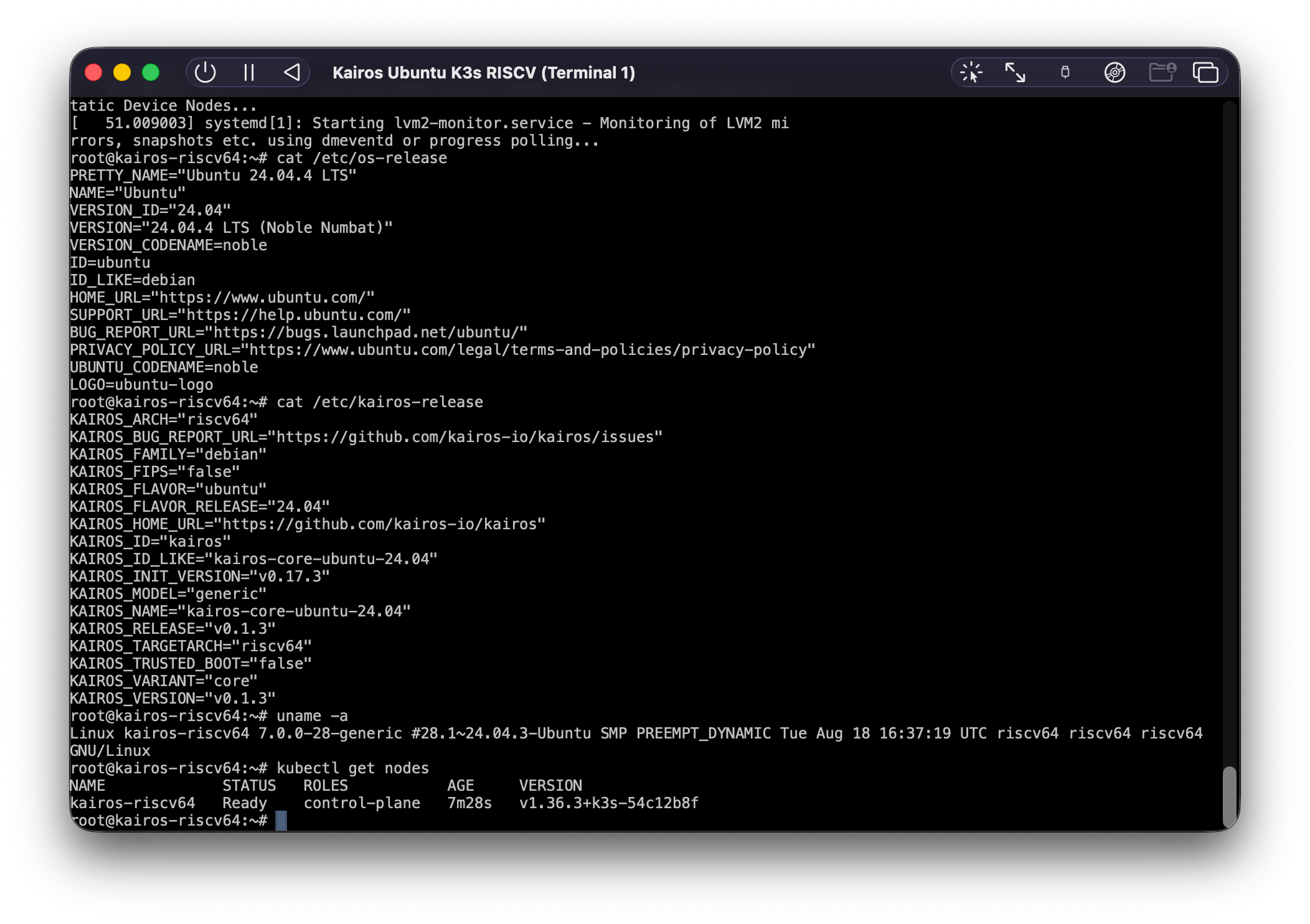
As you can see, this is a Kairos system based on Ubuntu 24.04, running k3s, on riscv64. Exciting, but it's way too soon to call victory: none of this has been tested on real hardware yet. Report what breaks, and we'll work through the fixes together.
Where things stand
The Ubuntu base comes straight from upstream. k3s comes from CARV-ICS-FORTH's actively-maintained riscv64 fork, since k3s has no official riscv64 release yet. There's an open upstream ticket to change that: k3s-io/k3s#7151. The same is true for k0s: k0sproject/k0s#1919. One way to help without touching any hardware: go show interest on those tickets, it moves us closer to official releases.
Worth mentioning too: Hadron, the minimal, upstream-first base Kairos is moving toward, already builds and passes its own tests on riscv64 in CI. There's just no public release with it yet.
Downloading the system image
A quick note before you download: this isn't an official Kairos release. Kairos officially only ships Hadron-based images today, and as I mentioned, there's no official riscv64 support yet either. On top of that, the unofficial k3s build needs a few hacks bolted onto the normal kairos-init flow that aren't going to land in kairos-init itself. So for now, this image lives on my own personal repo, not an official Kairos channel.
Download the ISO from the latest release. Boot it (qemu-system-riscv64, or real riscv64 hardware if you have it) and tell me if and where it breaks, with as much detail as you can give me. We'll work through a fix together, and you can help me keep testing from there.
The raw disk image (for flashing straight to hardware, no installer step) is too big for a GitHub release asset, so it's published as a scratch OCI image on Quay instead:
export IMAGE=quay.io/mauromorales/kairos-riscv64:0.1.3-img
container=$(docker create "$IMAGE" noop)   # scratch image, never executed
docker cp "$container:/output/." .
docker rm "$container"
That's it. Now you should have an image to test on your device.
If your device boots successfully
The next step is to actually install Kairos. I've left a very basic cloud-config you can use as a starting point, but feel free to write your own, backed by the Kairos configuration reference.
You can install it manually with the agent:
kairos-agent manual-install --device auto path/to/your/cloud-config.yaml
Then shut down and make sure the CD isn't mounted, if that's how you installed. The next time the system boots, it shouldn't show the installer option on GRUB anymore, and your system should be installed.
Open issues on kairos-io/kairos, and I'll address them directly with you. If what you hit is actually about k3s or k0s themselves, rather than Kairos, open it upstream instead: k3s-io/k3s#7151 or k0sproject/k0s#1919.
Thanks!